
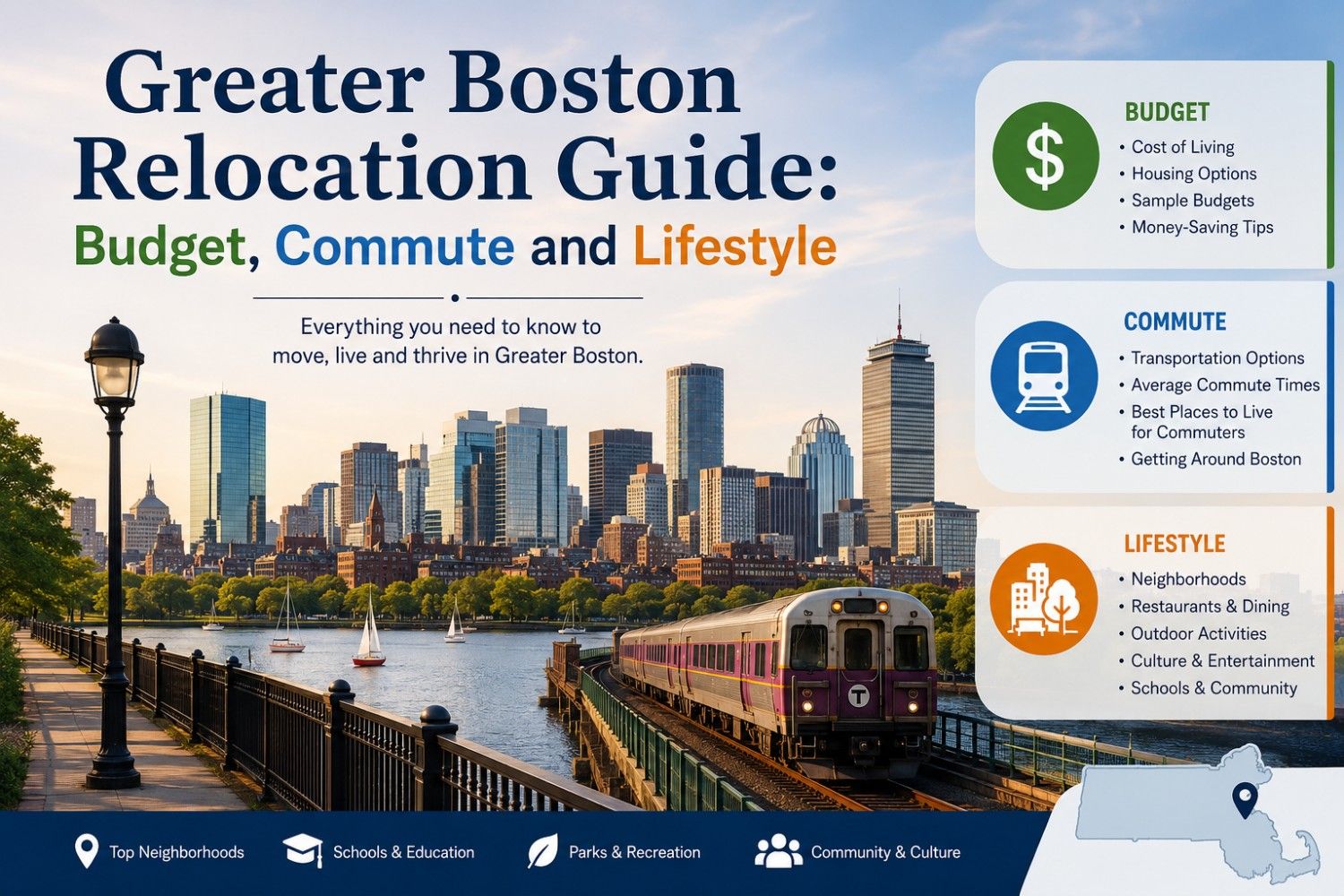
Greater Boston Relocation Guide: Budget, Commute and Lifestyle
Relocating to Boston is an exciting opportunity but it can also feel overwhelming if you are unfamiliar with the region. Unlike many cities, Greater Boston is not defined by a single downtown area. Instead, it is a network of distinct cities, towns and neighborhoods, each offering different housing options, commute experiences and lifestyles.
Whether you are searching for Greater Boston apartments, browsing apartments for rent, looking at homes for sale near me or working with a realtor to buy your first property, understanding the region before you move can save you time, money and frustration.
The biggest mistake many newcomers make is choosing a home based solely on price. In Greater Boston, your commute, neighborhood character, transit access and daily lifestyle can have just as much impact on your overall quality of life as your housing costs.
This guide breaks down everything you need to know about budgeting, commuting and choosing the right area when relocating to Boston in 2026.
Understanding Greater Boston
When people talk about Boston, they are often referring to a much larger region that includes:
- Boston
- Cambridge
- Brookline
- Somerville
- Newton
- Quincy
- Medford
- Waltham
- Malden
- Revere
Each area offers a different balance of:
- Housing costs
- Commute times
- School quality
- Walkability
- Lifestyle amenities
Someone working in Downtown Boston may have completely different housing priorities than someone employed in Kendall Square, Longwood Medical Area or along Route 128.
That is why successful relocations begin with understanding your daily routine rather than simply searching for the lowest-priced apartment.
Budgeting for a Move to Greater Boston
One of the first things newcomers notice is that housing costs in Greater Boston are significantly higher than in many other parts of the country.
However, housing expenses are only one piece of the puzzle.
When creating a relocation budget, consider:
- Monthly rent or mortgage payments
- Utilities
- Transportation costs
- Parking fees
- Commuter rail or MBTA passes
- Childcare expenses
- Property taxes (for buyers)
- Moving and storage costs
For renters, move-in expenses can also include:
- First month’s rent
- Last month’s rent
- Security deposit
- Broker fees
These upfront costs can be substantial, especially in highly competitive rental markets.
Many people relocating to Boston focus solely on rent and underestimate how much commuting, parking and transportation can affect their monthly budget.
In some cases, paying slightly more for housing closer to work can actually reduce overall living expenses.
Choosing Between Renting and Buying
If you are moving to the area for the first time, renting often provides flexibility while you learn the region.
Greater Boston apartments allow newcomers to:
- Explore different neighborhoods
- Learn local commute patterns
- Understand school districts
- Evaluate long-term preferences
Renting can be especially beneficial for professionals relocating from outside Massachusetts who are unfamiliar with the local housing market.
However, buyers planning to stay for several years may benefit from exploring homes for sale near me early in the process, particularly in communities with strong long-term appreciation potential.
A knowledgeable realtor can help determine whether renting or buying makes the most financial sense based on your timeline and goals.
Best Areas for Relocation in Greater Boston
Boston: Best for Urban Living
Boston remains the center of the region’s cultural, educational and professional activity.
The city appeals to residents who value:
- Walkability
- Public transportation
- Entertainment
- Sports
- Dining
- Urban energy
Popular neighborhoods include:
- Back Bay
- South End
- Beacon Hill
- Fenway
- Seaport
While Boston offers unmatched convenience, it also comes with some of the highest housing costs in the region.
For many newcomers, the tradeoff is worthwhile because they can walk to work, use public transit and enjoy city amenities without relying heavily on a car.
Cambridge: Ideal for Tech and Biotech Professionals
Cambridge attracts residents from around the world because of its connection to:
- Harvard University
- MIT
- Kendall Square
- Major biotech employers
The city offers exceptional walkability and strong transit access while maintaining a distinct neighborhood identity.
For professionals working in research, technology, healthcare or higher education, living in Cambridge can dramatically reduce commute times and improve work-life balance.
Housing costs remain high but many residents view the convenience and career opportunities as valuable long-term benefits.
Brookline: Family-Friendly and Walkable
Brookline is often one of the first communities families explore when relocating to Boston.
The town is known for:
- Strong public schools
- Walkable neighborhoods
- Transit access
- Community atmosphere
Areas such as Coolidge Corner and Brookline Village offer a unique combination of suburban comfort and urban convenience.
Brookline appeals to buyers who want access to Boston without living directly in the city.
Somerville: Popular Among Young Professionals
Somerville has become one of Greater Boston’s most desirable housing markets.
The city offers:
- Vibrant neighborhoods
- Excellent restaurants
- Transit access
- Strong rental demand
- Proximity to Boston and Cambridge
Neighborhoods such as Davis Square, Union Square and Assembly Row continue attracting renters and buyers seeking a dynamic urban environment with slightly different pricing than Boston’s core neighborhoods.
For many newcomers, Somerville provides an attractive balance between convenience and lifestyle.
North Shore, South Shore and MetroWest: More Space and Different Priorities
Many people relocating to Boston eventually discover that their lifestyle priorities point them outside the urban core.
The North Shore includes communities such as:
- Salem
- Beverly
- Marblehead
- Peabody
These areas appeal to residents seeking coastal living, larger properties and a slower pace.
The South Shore includes communities like:
- Quincy
- Hingham
- Braintree
These towns offer strong commuter access while maintaining a more suburban environment.
MetroWest communities such as:
- Newton
- Natick
- Framingham
- Wellesley
are particularly attractive to families and professionals seeking larger homes, strong schools and convenient highway access.
While commute times may be longer, many residents value the additional space and neighborhood atmosphere.
Understanding Your Daily Commute
Your commute may ultimately be the most important factor in choosing where to live.
Before selecting a neighborhood, ask yourself:
- How often will I be in the office?
- Do I rely on public transportation?
- Do I need parking?
- Will I commute into Boston, Cambridge or another employment center?
- How much travel time am I comfortable with each day?
A neighborhood that seems affordable on paper may become less appealing if it adds two hours of commuting to your daily routine.
That is why many relocation experts recommend testing commute routes before committing to a lease or purchase.
Lifestyle Matters as Much as Housing Costs
Every Greater Boston community offers a different lifestyle experience.
Some buyers prioritize:
- Walkability
- Restaurants
- Nightlife
- Transit access
Others focus on:
- School systems
- Yard space
- Community feel
- Long-term family living
Neither approach is right or wrong.
The goal is finding a neighborhood that aligns with how you actually live rather than how you imagine you will live.
A young professional working in Kendall Square will likely prioritize different amenities than a family moving to the region with school-age children.
Why Working With a Local Realtor Matters
Relocating to Boston often involves navigating dozens of communities, neighborhoods and housing options.
A local realtor can help you:
- Compare neighborhoods objectively
- Understand pricing trends
- Evaluate commute options
- Identify emerging markets
- Avoid common relocation mistakes
Local expertise becomes especially valuable when comparing areas that may look similar online but offer very different daily living experiences.
The right guidance can save both time and money during your move.
Greater Boston Relocation Checklist
Before making your move, make sure you:
✓ Define your housing budget
✓ Map your commute
✓ Decide whether renting or buying makes more sense
✓ Research schools if applicable
✓ Explore multiple neighborhoods
✓ Understand transportation options
✓ Account for moving expenses and deposits
✓ Work with an experienced local realtor
Taking these steps early can make your transition significantly smoother.
Ready to Relocate to Greater Boston?
Relocating to a new city is about more than finding a place to live. It is about finding the right neighborhood, commute, and lifestyle for your long-term goals. At Fenway Property Advisors, we help individuals, families and professionals navigate the Greater Boston market with confidence. Whether you are searching for Greater Boston apartments, exploring homes for sale, or trying to understand which community best fits your needs, our local expertise can help simplify the process.
Final Thoughts on Relocating to Boston
Relocating to Boston is about much more than finding a place to live. It is about finding the right balance between budget, commute and lifestyle.
Greater Boston apartments, suburban homes, urban condos and family-friendly neighborhoods all offer different advantages. The best choice depends on your goals, career, family needs and long-term plans.
Whether you are searching apartments for rent in the city, exploring homes for sale near me in surrounding communities or preparing to buy your first home with the help of a realtor, understanding the region before you move will help you make a more confident decision.
Greater Boston remains one of the country’s most desirable places to live because it offers strong job opportunities, excellent education, vibrant neighborhoods and long-term housing demand. The key is finding the community that fits your life, not just your budget.
FAQ About Relocating to Boston
Is Boston expensive to live in?
Yes. Housing costs are generally higher than the national average but salaries and job opportunities are often stronger as well.
Should I rent before buying when relocating to Boston?
Many newcomers choose to rent first so they can learn the region and identify neighborhoods that best fit their lifestyle.
What is the best area for families?
Brookline, Newton, Wellesley and several MetroWest communities are popular choices for families.
Which areas are best for young professionals?
Boston, Cambridge and Somerville remain among the most popular destinations for young professionals.
How important is commute planning?
Extremely important. Commute times can vary significantly depending on where you live and work.
Do I need a realtor when relocating to Boston?
Working with a local realtor can provide valuable insight into neighborhoods, pricing and housing options throughout Greater Boston.